.png)
What Happens in Your Brain When You Meditate?
For centuries, meditation has been valued for its ability to create calm and clarity. Today, advances in neuroscience allow us to observe what happens in the brain during meditation with remarkable detail. Using technologies such as electroencephalography (EEG), which measures electrical brain activity, and functional magnetic resonance imaging (fMRI), which measures changes in blood flow associated with brain activity, researchers have discovered that meditation influences multiple brain networks involved in attention, emotion and self-awareness.
One of the earliest changes observed is a reduction in high-frequency beta brainwave activity, associated with active thinking, problem-solving and mental chatter, alongside an increase in slower alpha and theta activity, which are linked with relaxation, focused attention and internal awareness.
Even if you're new to meditation or feel like you "didn't do it right", studies suggest that a single 20-minute session can produce measurable changes in brain activity.
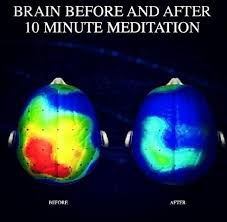
In the image below, you can see this in action: the left side shows high beta wave activity (bright colours) before meditation, while the right side shows a dramatic reduction during meditation.
So, what is happening?
How Meditation Reshapes the Brain
Modern neuroscience has revealed fascinating insights into how meditation affects the brain- and the effects go far beyond relaxation.
Frontal Lobe
During meditation, activity within parts of the prefrontal cortex often becomes quieter, reducing the constant planning, analysing and internal dialogue that occupy much of everyday thinking. This temporary reduction allows attention to shift from external demands towards present-moment awareness.
Parietal Lobe
The parietal lobe processes sensory information and helps us orient ourselves in time and space. Meditation reduces activity here, softening our awareness of the external world and creating a deeper sense of internal focus. This contributes to the feeling that the boundaries between ourselves and the outside world become softer, something many experienced meditators describe during deeper practice.
Thalamus
Acting as the brain’s sensory gatekeeper, the thalamus filters incoming data. During meditation, this filtering process slows dramatically, decreasing the flow of information and enhancing mental stillness.
Reticular Formation
This structure helps the brain stay alert by receiving sensory input and priming us to react. Meditation dials down this arousal response, shifting the brain into a more restful and less reactive state. This reduction in arousal helps explain why meditation often produces a feeling of calm alertness rather than drowsiness.
Meditation Changes the Brain Over Time
The most compelling discovery is that with consistent practice, these changes don't just occur during meditation - they start to persist throughout the day, even when you're not meditating.
Over weeks and months of consistent practice, the brain begins to reinforce these calmer patterns through neuroplasticity. What initially requires conscious effort gradually becomes more automatic, allowing many people to respond to everyday stress with greater calm and emotional balance.
Some call this “inner peace.” It doesn’t happen overnight, but it’s a powerful, lasting transformation.
The “Me Centre” and Anxiety
Meditation also helps rewire the brain’s emotional response system. One key area affected is the medial prefrontal cortex. The medial prefrontal cortex is sometimes described as part of the brain's self-referential network because it is involved in thinking about ourselves and our experiences.
Without meditation, the neural pathways and the brain’s fear and sensation centres (like the amygdala) are typically strong. That’s why uncomfortable sensations - like pain or fear - can feel personal and overwhelming. For instance, a small ache can trigger anxiety by lighting up the Me Centre with stories like “something’s wrong with me.”
Meditation weakens this reactive connection, allowing us to observe sensations without becoming emotionally entangled in them.
Research also suggests that regular meditation enhances communication between areas involved in emotional regulation and executive function. This may help explain why experienced meditators are often better able to pause, evaluate situations and respond thoughtfully rather than reacting automatically.
Empathy, Compassion, and the Emotional Brain
Regular meditation also boosts empathy and compassion. In one study, participants were shown emotionally charged images - both positive and negative - while practising compassion meditation. Even when not meditating, these individuals displayed greater control over their emotional responses and higher levels of compassion, especially when viewing distressing images.
This shift is partially attributed to the amygdala, the brain’s emotional processing hub. While meditation usually calms the amygdala, it becomes more selectively responsive when practitioners encounter suffering - indicating a balanced, thoughtful response rather than emotional shutdown.
A 2008 study further showed that people who meditate regularly exhibit increased activation in the temporal parietal junction, a brain region strongly associated with empathy. When they heard sounds of people in pain, their brains responded more deeply than those of non-meditators.
In Summary
Meditation is far more than a relaxation technique. Research shows that regular practice can influence the structure and function of the brain through the process of neuroplasticity, helping to strengthen attention, emotional regulation, empathy and resilience.
Although the effects develop gradually, each meditation session represents another opportunity for the brain to reinforce healthier neural pathways. Over time, these small changes accumulate, creating lasting improvements in how we think, feel and respond to life's challenges.
This is why meditation forms one of the core practices within the Seasonal Integration Method™. Before lasting change can occur, we first need the awareness to observe ourselves with curiosity rather than judgement. Meditation provides that space, allowing the mind to become quieter, the nervous system to settle and new possibilities to emerge.
Further Reading
Davidson, R. J., & Goleman, D. (2017). Altered Traits: Science Reveals How Meditation Changes Your Mind, Brain and Body.
Hölzel, B. K., Lazar, S. W., Gard, T., Schuman-Olivier, Z., Vago, D. R., & Ott, U. (2011). How Does Mindfulness Meditation Work? Proposing Mechanisms of Action From a Conceptual and Neural Perspective. Perspectives on Psychological Science, 6(6), 537–559.
Lazar, S. W., Kerr, C. E., Wasserman, R. H., et al. (2005). Meditation Experience Is Associated with Increased Cortical Thickness. NeuroReport, 16(17), 1893–1897.
Tang, Y. Y., Hölzel, B. K., & Posner, M. I. (2015). The Neuroscience of Mindfulness Meditation. Nature Reviews Neuroscience, 16(4), 213–225.


Comments