.png)
The neuroscience behind one of the world's oldest wellbeing practices.
Updated: Jul 6
These discoveries help explain why meditation has become one of the core practices within the Seasonal Integration Method™, supporting awareness, emotional regulation and sustainable personal growth.
Meditation has been practised for thousands of years, long before modern neuroscience had the tools to understand what was happening inside the brain.
Today, advances in brain imaging have allowed researchers to observe many of the neurological changes that occur during meditation, helping explain why this ancient practice can support emotional wellbeing, attention, resilience and nervous system regulation.
Within the Seasonal Integration Method™, meditation is one of the core practices that creates the awareness and safety needed for sustainable personal growth.

In its simplest form Meditation is a practice that helps people achieve balance:
* Mentally * Physically * Emotionally *
We all know relaxation is beneficial to health yet we all know that you cannot just switch a switch and relax. Meditation is the key to that switch.
It is said if you are too busy to meditate for 10 mins a day then you should be meditating for 20. But in all honesty, even 2 mins a day will bring benefits over time – if you start with a tiny habit and consistently achieve it – it will grow.
There are different ways to meditate but there are two types which are the usual focus of scientific research.
1 Focused Attention Meditation which is where you focus on one specific thing—it could be your breathing, a sensation in your body or a particular object outside of you. The point of this type of meditation is to focus strongly on one point and continually bring your attention back to that focal point when it wanders.
2 Open Monitoring Meditation (Mindfulness) An accepting awareness of the present moment ie paying attention to all of the things happening around you without reacting.
What Happens in the Brain During Meditation?
This is where things get really interesting. Using MRI scans, scientists have developed a more thorough understanding of what’s taking place in our brains when we meditate. At a basic level, we stop thinking ie we stop processing information.
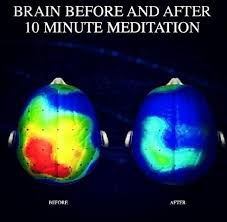
Via the scan, you can see Beta waves in action as we process information, and then during meditation, you can see these Beta waves physically decreasing.
Busy waking thought is commonly associated with beta activity. As attention settles, many people show increases in alpha and theta activity, associated with relaxed awareness and inward attention. With deeper practice, some people may briefly enter delta, while experienced meditators have also demonstrated periods of increased gamma activity linked to heightened awareness and integration of both sides of the brain coming into balance.
Even if you have never tried meditation before or you have and you think you have failed – the scan will show that your Beta waves will have slowed down.
In the image below you can see how the beta waves (shown in bright colours on the left) are dramatically reduced during meditation (on the right).

In one of the largest studies of its kind to date, published in the journal NeuroImage, a team of researchers at the Center for Healthy Minds at the University of Wisconsin–Madison examined brain activity in non-mediators, new mediators, and long-term meditators with thousands of hours of experience.
Using functional resonance imaging they were able to show the differences in the emotion networks of the brain in people who don’t meditate, people new to meditation, and people considered long-term meditators.
The researchers discovered differences in emotion networks of the brain among these groups.
“alterations in key brain circuits
associated with emotion regulation can be
produced by mindfulness meditation,”
Says Richard Davidson, William James and Vilas Professor of Psychology and Psychiatry at UW–Madison, who led the work.
Both long-term practitioners and new mediators – when compared to non-mediators – showed reduced activity in the Amygdala when they viewed emotionally positive images. The Amygdala is an area of the brain critical for emotion and detecting important information from the environment.
In addition, the team discovered that with just eight weeks of training, people new to meditation showed an increase in connectivity between the Amygdala and an area of the brain that supports executive function (which includes self-regulation and goal tracking) and emotion, the Ventromedial prefrontal cortex.
“These findings are important in demonstrating functional changes
in a key circuit underlying emotion regulation
after just eight weeks of mindfulness practice,”
says Davidson.

So what is happening throughout the brain.
Brain Area | During Meditation |
Frontal Lobe | Less mental chatter |
Parietal Lobe | Greater present awareness |
Thalamus | Reduced sensory overload |
Reticular Formation | Calmer nervous system |
Amygdala | Reduced emotional reactivity |
Frontal lobe This is the most highly evolved part of the brain, responsible for reasoning, planning, emotions and self-conscious awareness.
During meditation, the frontal cortex switches off.
Parietal lobe This part of the brain processes sensory information about the surrounding world, orienting you in time and space.
During meditation, activity in this lobe slows down.
Thalamus The gatekeeper for the senses, this organ focuses your attention by funneling some sensory data deeper into the brain and stopping other signals in their tracks.
Meditation reduces the flow of incoming information to a trickle.
Reticular formation As the brain’s sentry, this structure receives incoming stimuli and puts the brain on alert, ready to respond.
Meditating dials back the arousal signal.
The real interesting thing is that over time when you mediate daily there comes a point where your brain continues in this state even when you are awake and going about your daily business – call it inner peace if you wish – but getting to this state takes time – but it’s a beautiful place to be in.
Meditation Is More Than Relaxation
Many people believe meditation is simply about relaxing.
Relaxation is certainly one benefit, but modern neuroscience suggests meditation also influences attention, emotional regulation, self-awareness and neuroplasticity.
Over time, these changes can support healthier habits, greater resilience and a calmer relationship with thoughts and emotions.
For the more technical-minded out there
The more we meditate, the less anxiety we have, this is because we are loosening the connections of particular neural pathways.
What happens without meditation is that these sections of our brain that are sometimes called the Me Center (ie the medial prefrontal cortex – the part that processes information relating to ourselves and our experiences) get tight.
Normally the neural pathways from the bodily sensation and fear centers of the brain to the Me Center are really strong. For example, when you experience a scary or upsetting sensation, it triggers a strong reaction in your Me Center, making you feel scared and under attack.
When we meditate, we weaken this neural connection. This means that we don’t react as strongly to sensations that might have once lit up our Me Centers. As we weaken this connection, we simultaneously strengthen the connection between what’s known as our Assessment Center (the part of our brains known for reasoning) and our bodily sensation and fear centres. So when we experience scary or upsetting sensations, we can more easily look at them rationally.
For example, when you experience pain, rather than becoming anxious and assuming it means something is wrong with you, you can watch the pain rise and fall without becoming ensnared in a story about what it might mean.
Why This Matters
Meditation doesn't change life overnight, nor does it remove difficult thoughts or emotions. Instead, it gradually changes the way the brain responds to them.
With regular practice, meditation can strengthen emotional regulation, reduce reactivity, improve attention and support the nervous system in returning to a calmer, more balanced state.
This is why meditation forms one of the core practices within the Seasonal Integration Method™. It creates the awareness, safety and clarity needed for meaningful, sustainable change to unfold.
Reflect
Have you noticed any changes in your thoughts, emotions or reactions since beginning meditation?
Even small shifts are worth observing-they are often the first signs of lasting change.
Key Takeaways
• Meditation changes how the brain processes information.
• Regular practice strengthens emotional regulation.
• Brainwave activity shifts as attention turns inward.
• Meditation supports nervous system regulation.
• Lasting change develops through consistent practice.
Reflect
Have you noticed any changes in your thoughts, emotions or reactions since beginning meditation?
Even small shifts are worth observing-they are often the first signs of lasting change.
Explore next...
The Science of Sustainable Change
Nervous System Regulation
Brainwave States Explained


Comments